
How Difficult Is Adventure Riding in Cyprus — and When Should You Come?
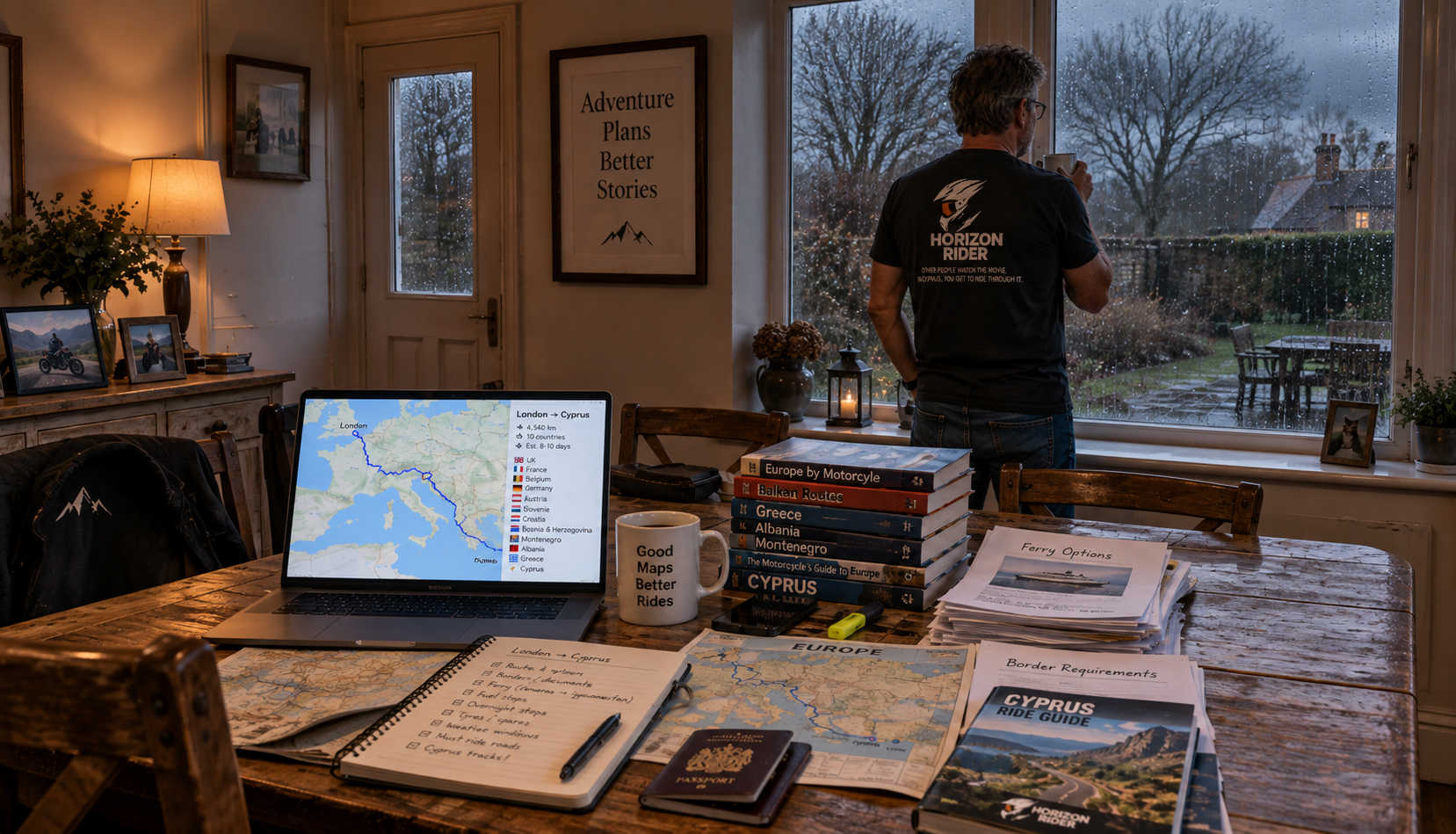
One of the questions I'm asked most often about riding in Cyprus is:
How difficult is it?
It's a perfectly reasonable question. Unless you're a local, the chances are you've got very little experience of riding here. Cyprus sits right at the eastern edge of Europe and, as we've established elsewhere, getting your own motorcycle here isn't exactly a casual weekend ride.
Unfortunately, it's also almost impossible to answer.
I've ridden trails here that I'd happily send a relatively inexperienced off-road rider along in October, yet I'd think rather more carefully about sending the same person down the same trail in March.
The trail hasn't moved.
Cyprus has.
Rain turns dust into mud. Dry limestone becomes wet limestone. A harmless-looking riverbed acquires a significant river. A climb you barely noticed in November suddenly requires considerably more commitment, and somewhere you've ridden twenty times can develop a rut, washout or rock step that wasn't there the last time.
If you've ridden northern Europe, where you can encounter mud so deep that you can dismount your motorcycle and it remains standing perfectly happily without you, let me tell you that I've done exactly the same thing here.
Then there is the motorcycle underneath you, the direction you're travelling, how much luggage you're carrying, how tired you are and, most importantly, what you mean by difficult.
So if somebody asks me whether adventure riding in Cyprus is easy, intermediate or hard, the only completely accurate answer I can give is:
Yes.
Harder doesn't automatically mean better
This is worth getting out of the way early.
There is a slightly strange tendency in adventure riding to treat difficulty as a measure of quality. If one trail is harder than another, somehow it must be the better ride.
I don't agree.
Some of my favourite riding in Cyprus isn't particularly difficult at all. There are long, flowing tracks through forests where you can relax, let the motorcycle move underneath you and simply enjoy where you are. You can safely exercise your inner Pol Tarrés, rooster-tailing around every corner and just enjoy the experience. There are trails along ridges with unbelievable drops and enormous views, fast gravel sections, vineyard tracks and routes twisting through valleys where the riding itself is almost effortless.
They're utterly brilliant.
Elsewhere you'll find loose rocky climbs, steep descents, ruts, washouts and sections where you'll stop before committing yourself and have a proper look. A rocky path in June can become a spectacularly flowing river crossing in January.
They're brilliant too.
But they're brilliant for completely different reasons.
The objective isn't to find the hardest possible way across Cyprus. If that were the objective, I could probably construct a 20 km route that ruined everybody's holiday before lunch.
In fact, if you're mean to me, I might just slip it into your GPX...
The objective here is to find riding worth riding.
Sometimes that's technical.
Sometimes it isn't.
Your motorcycle gets a vote
Difficulty isn't simply a property of the trail.
The motorcycle matters enormously.
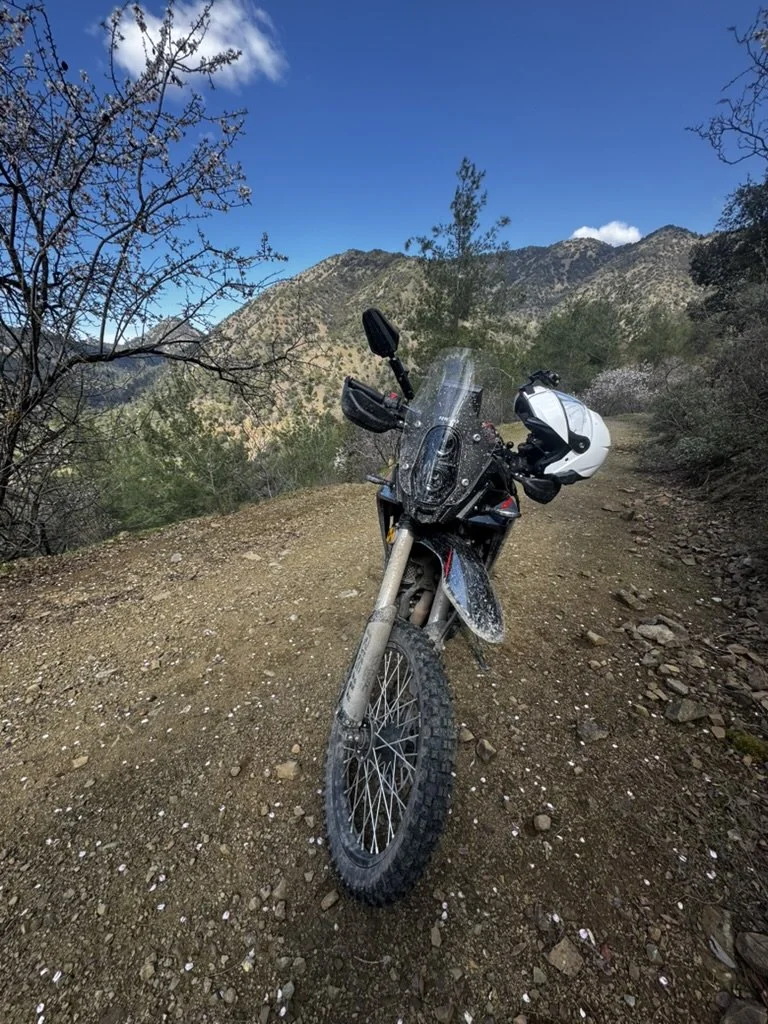
A rocky climb on a 150 kg motorcycle with proper dirt tyres is not the same rocky climb on a 240 kg adventure bike on 50:50s carrying aluminium panniers, camping equipment and the accumulated contents of somebody's garage.
Both motorcycles may get to the top.
One of them is simply going to ask rather more questions on the way.
It's one of the reasons I think relatively light adventure bikes work so well here. Cyprus has enough flowing sections and longer days that a pure enduro bike isn't necessarily the perfect answer, but once you're off-road, manageable weight becomes your friend very quickly.
That doesn't mean you can't bring your 1200GS, Africa Twin or equivalent. Plenty of experienced riders can do remarkable things with big motorcycles. I regularly ride for fun with a group consisting of four Ténéré 700s, a KTM 890 and a Honda 750 Africa Twin.
But if you ask me whether a particular HAT is difficult, what you're riding is part of the answer.
So is what you've strapped to it.
Thirty kilograms of luggage doesn't cease to exist simply because Touratech made the boxes.
You get a vote too
Then there's the rider.
I've watched somebody look at a section I barely thought about and decide it was beyond them.
I've also watched riders attack something I'd stopped to inspect and disappear up it as though somebody had laid tarmac five minutes earlier. In fact, the rider of that Africa Twin I mentioned earlier is renowned for believing he's a mountain goat.
Neither tells us whether the trail is objectively difficult.
It tells us we're different riders.
Experience changes what you see. So does confidence. So does whether you've spent the last ten years riding enduro bikes or whether your idea of off-road riding until recently was a well-maintained gravel road.
And that's absolutely fine.
Cyprus isn't an exam.
There isn't a certificate at the end saying you successfully rode every difficult section in Cyprus, and nobody gets extra points for arriving back at The Cottage with half a motorcycle and a thousand-yard stare.
If something doesn't look like fun, don't ride it.
There is almost always another way.
Direction can change everything
This is one of my favourites. You ride a trail one day and think:
That was a cracking climb.
Then six months later you approach exactly the same trail from the opposite direction and discover that your cracking climb has become a steep, loose descent covered in rolling rock.
Ah.
Same trail. Same motorcycle. Same rider.
Completely different proposition.
There are sections of the HAT network where direction materially changes the character of the ride. A rocky step that's entertaining going up may require considerably more thought going down. A loose descent can become a lovely climb. Water crossings can have easier entries from one side than the other.
This is another reason I'm reluctant to attach one definitive difficulty number to a line on a map.
Which way are you going?
And then Cyprus adds water
This is where season enters the story.
For much of the riding year, Cyprus can be extraordinarily forgiving. The ground is dry, visibility is excellent and you can cover distance surprisingly quickly.
Then it rains.
The limestone here deserves particular respect when it's wet. Something that offered perfectly respectable grip yesterday can become impressively uncooperative today.
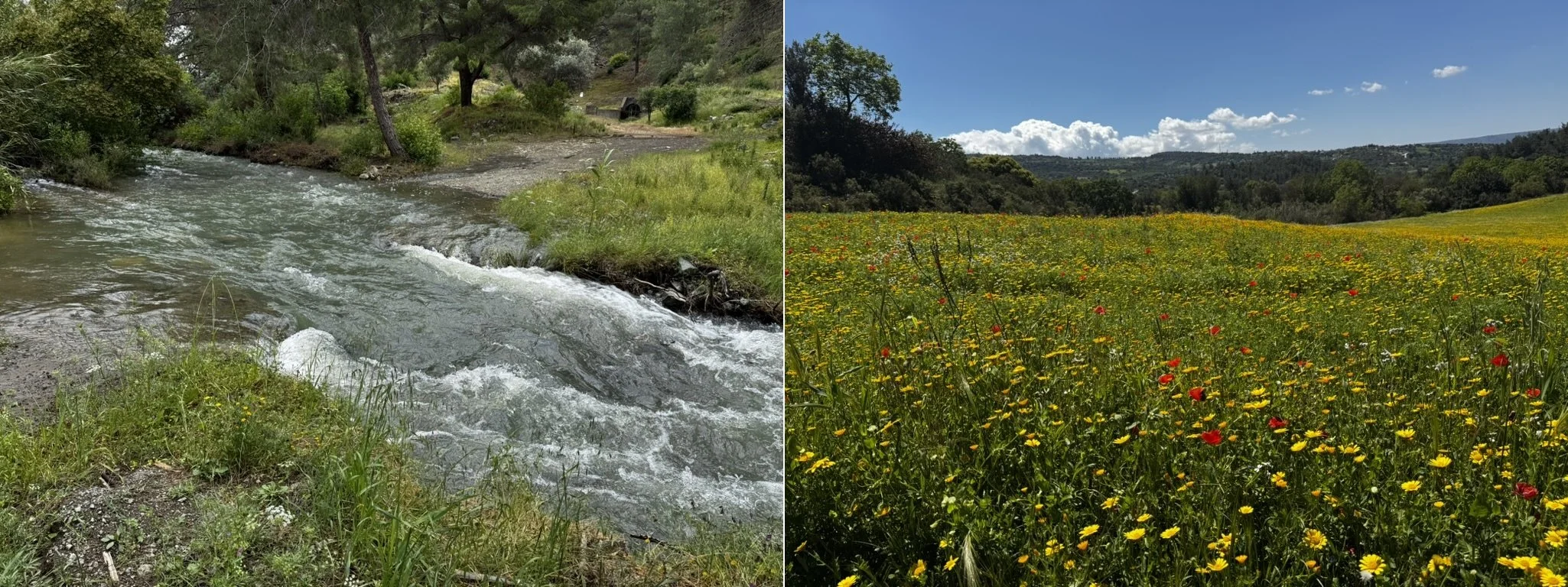
Mud appears. Ruts fill with water. River crossings become actual river crossings rather than slightly damp interruptions to your day.
Some require you to change into your brave pants before the attempt.
And the character of entire sections changes.
I rode more than twenty days here during March conditions this year, and I rather enjoy it. But it's a very different Cyprus from the one you'll find later in spring or during autumn.
There can be mud, wet limestone and proper flowing water. I've had days with crossing after crossing where the challenge wasn't simply getting through the water, but working out what the bottom was doing underneath it.
That's fun if that's what you've come for.
If your idea of a perfect ADV holiday is long flowing tracks, sunshine and stopping occasionally to photograph the view, there are better months to choose.
March is not October
This is probably the simplest way I can explain Cyprus seasonality.
A photograph of a trail tells you surprisingly little unless you know when it was taken.
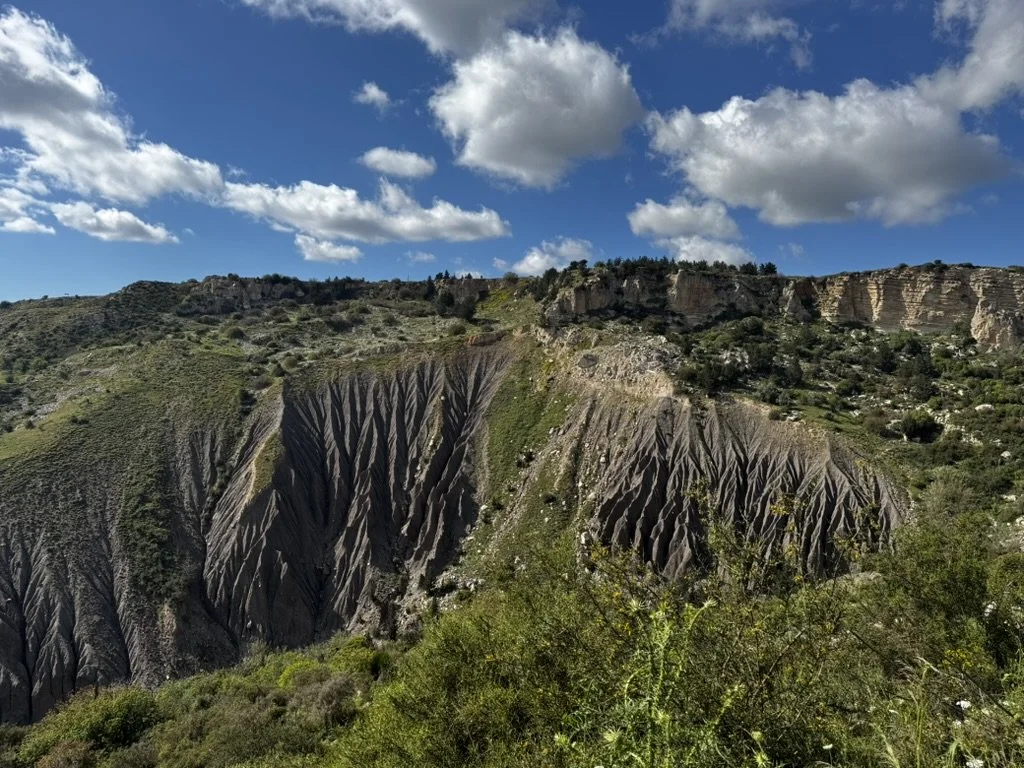
March can be Ireland levels of green, beautiful and spectacular. It can also be wet, muddy and considerably more technical than somebody expecting the stereotypical dry Mediterranean island might imagine.
For Horizon Rider, March is therefore something I'd regard as a month for reasonably experienced riders. If you're comfortable when the bike starts moving around, don't mind mud and regard a river crossing as an interesting development rather than an administrative failure, you may absolutely love it.
Then Cyprus begins changing.
April and May are wonderful. The landscape is still green, the abundance of wildflowers is staggering, temperatures are generally much kinder and the riding begins to settle into that combination of grip, visibility and comfortable weather that makes spending all day on a motorcycle very easy to justify.
If somebody asked me for my favourite spring period, April and May would be very difficult to argue against.
June is incredibly enjoyable but now heat becomes part of the planning. Earlier starts become sensible, hydration matters more and I'd pay considerably more attention to how strenuous a proposed day is going to be.
I start resisting the temptation to have that extra glass of wine the evening before so I can be out of the door, timed to perfection, when the sun first peeks into the morning sky.
Then we reach July and August.
Forget July and August
I live here.
I love Cyprus.
I don't want to spend July and August wrestling an adventure motorcycle around the mountains all day.
It can be extremely hot. This isn't the pleasant “lovely day for a ride” warmth somebody imagines while sitting in northern Europe in February. I'd liken it to riding directly into a hairdryer turned up to eleven.
Sustained off-road riding is physical work, and doing physical work in serious Cyprus summer heat can move surprisingly quickly from uncomfortable to unsafe.
During those months, if I'm going out, I can be planning a 4am departure.
That's not because I have developed an unexpected passion for alarm clocks.
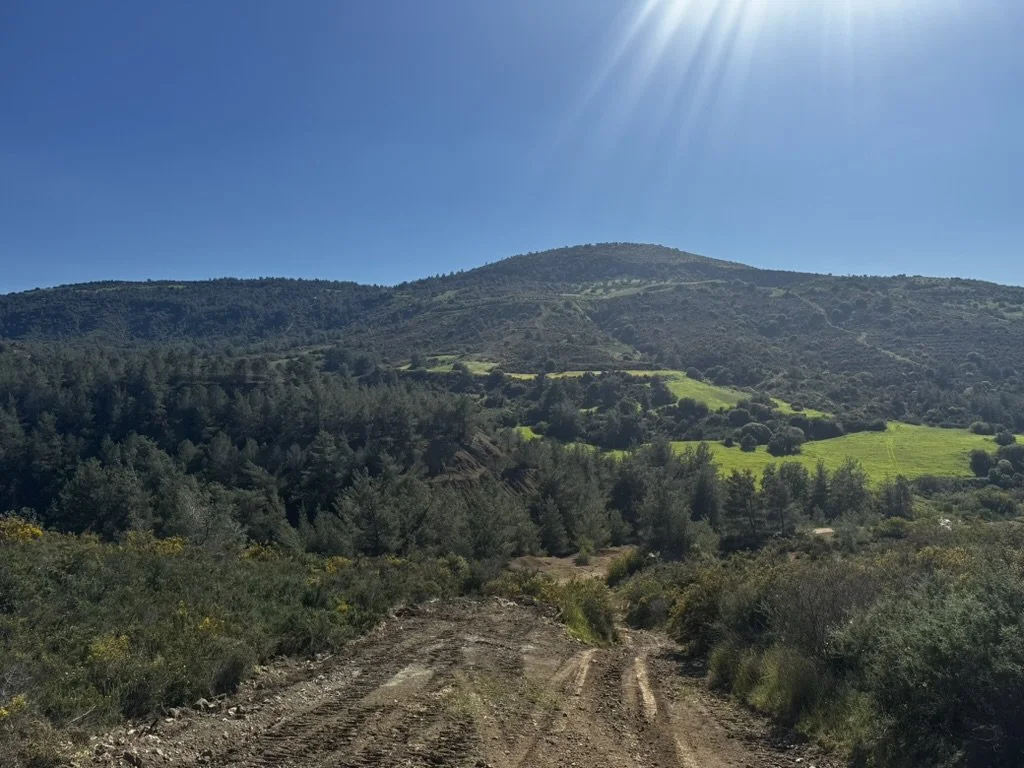
It's because I want the difficult part of the riding finished before the day becomes properly hot. I can be up in the mountains before the heat and enjoy temperatures that can be 20 degrees lower than at the coast.
This year, I had a rider actually faint while riding at around 40 km/h in summer heat. He crashed into me as he went down and we both ended up in a heap.
That rather focuses the mind.
The rest is a tale for around the campfire.
The point is, the motorcycles will be fine.
You are the component I'm more worried about.
So we don't try to pretend July and August are prime ADV months simply because that's when traditional Mediterranean tourism is at its busiest.
They're not.
There are better times to come.
Then autumn gives it back
As the serious summer heat retreats, Cyprus becomes a wonderful place to ride again.
October to December are three months I particularly love. The oppressive heat has gone, the trails are generally still dry and you can spend a long day on the motorcycle without organising the entire thing around hiding from the sun.
For me, these are right alongside April, May and June as our sweet spots.
September sits in the transition. Early September can still feel very much like summer, while later in the month things begin becoming considerably more attractive. We're right there as I write this and I've ridden almost every day.
It's been fantastic.
Then winter gradually changes the equation again.
Rain returns. Conditions become less predictable. The island greens up and the riding can be excellent, but you're moving back towards the version of Cyprus where weather can materially alter the difficulty of a route.
Horizon Rider closes in February. Trust me, it's miserable. I almost never ride unless we get a freak dry day. It also gives us some useful downtime to assess the fleet, order new bikes where necessary and modify them for the season ahead.
By March, we're back where we started: experienced riders, changing conditions and the possibility that yesterday's straightforward trail has developed a sense of humour overnight.
Difficulty also changes during the day
There's another variable that doesn't appear on a GPX file.
You get tired.
A technical climb at 09:30 after breakfast is not necessarily the same technical climb at 16:30 after seven hours standing on the pegs.
Concentration fades. Arms get tired. Decisions become slightly slower. Something you'd attack without thinking in the morning can look considerably less inviting late in the afternoon.
This is one of the reasons I don't particularly care about mileage as a measure of a day's adventure riding.
I've had a 75 km day take 11 hours.
A 200 km day on flowing tracks may be easier than 80 km of technical riding in difficult conditions.
So when you're choosing where to go, don't simply ask whether you can ride a section.
Ask whether you want to ride it now.
There's wisdom in turning around.
Usually it arrives shortly before traction disappears.
So when should you come?
If you want my simplest opinion:
April, May and June are superb. June is hotter, so earlier starts and hydration become increasingly important.
September can work beautifully, particularly later in the month as the serious summer heat begins to retreat.
October, November and December are superb.
I actually have a guy arriving the day after Christmas to ride this year. If he arrives in red trail gear and a big white beard, I will finally know how Santa decompresses after work.
March can be fantastic if you're experienced and actively enjoy more changeable, technical conditions.
July and August aren't months I'd recommend for sustained off-road adventure riding.
February we're closed.
The remaining winter period can offer excellent riding, but weather becomes a larger variable and conditions can change quickly.
But even that is only half an answer.
Because the better question isn't:
“How difficult is adventure riding in Cyprus?”
It's:
“How difficult do you want your adventure riding in Cyprus to be?”
Tell me when you're coming, what motorcycle you ride, how much off-road experience you've got and what sort of riding makes you grin inside your helmet.
And don't think you can only ask me if you're booking with us. That's not the case at all. One of the wonderful aspects of adventure riding is that ultimately, we are one big community. I'll help you if I can.
We don't bite.
Cyprus can give you easy, flowing days through spectacular scenery. It can give you loose climbs, wet limestone, mud and river crossings. It can give you 200 km that disappear underneath the wheels or 75 km that somehow consume the entire day.
That's the beauty of having a network rather than one compulsory route.
You don't have to ride the hardest Cyprus available.
You just have to ride the Cyprus that gives you a bloody good day.
Stretch your riding season
There is one final point worth making, particularly if you're reading this somewhere in northern Europe.
I'm British. I spent decades looking out of the window at miserable weather, knowing that technically I could go trail riding, provided I first dressed as though I was preparing to survive an Atlantic winter.
Cyprus is different.
Our riding season is enormously longer. What we regard as a chilly, slightly miserable winter day may look suspiciously like excellent riding weather to somebody staring out of a window in Britain, Germany or Scandinavia.
That's perhaps the bit that doesn't come across in a simple “when should I visit?” list.
You don't have to come to Cyprus because your own riding season has completely stopped. Come because ours hasn't.
So if you're sitting at home looking longingly towards the garage, wondering how many months it'll be before you can properly enjoy the bike again, perhaps don't wait.
Stretch your season.
Come and ride Cyprus.
