
Part 5 — What Actually Deserves a Place on Your Motorcycle?
Loadout: Stop Carrying the Workshop
We've done rather well so far. We set the sag, made the motorcycle fit the rider, changed the gearing to suit the job and even fiddled with those mysterious little clicky things until the suspension stopped behaving like either a pogo stick or a park bench.
The motorcycle is finally set up properly.
Excellent.
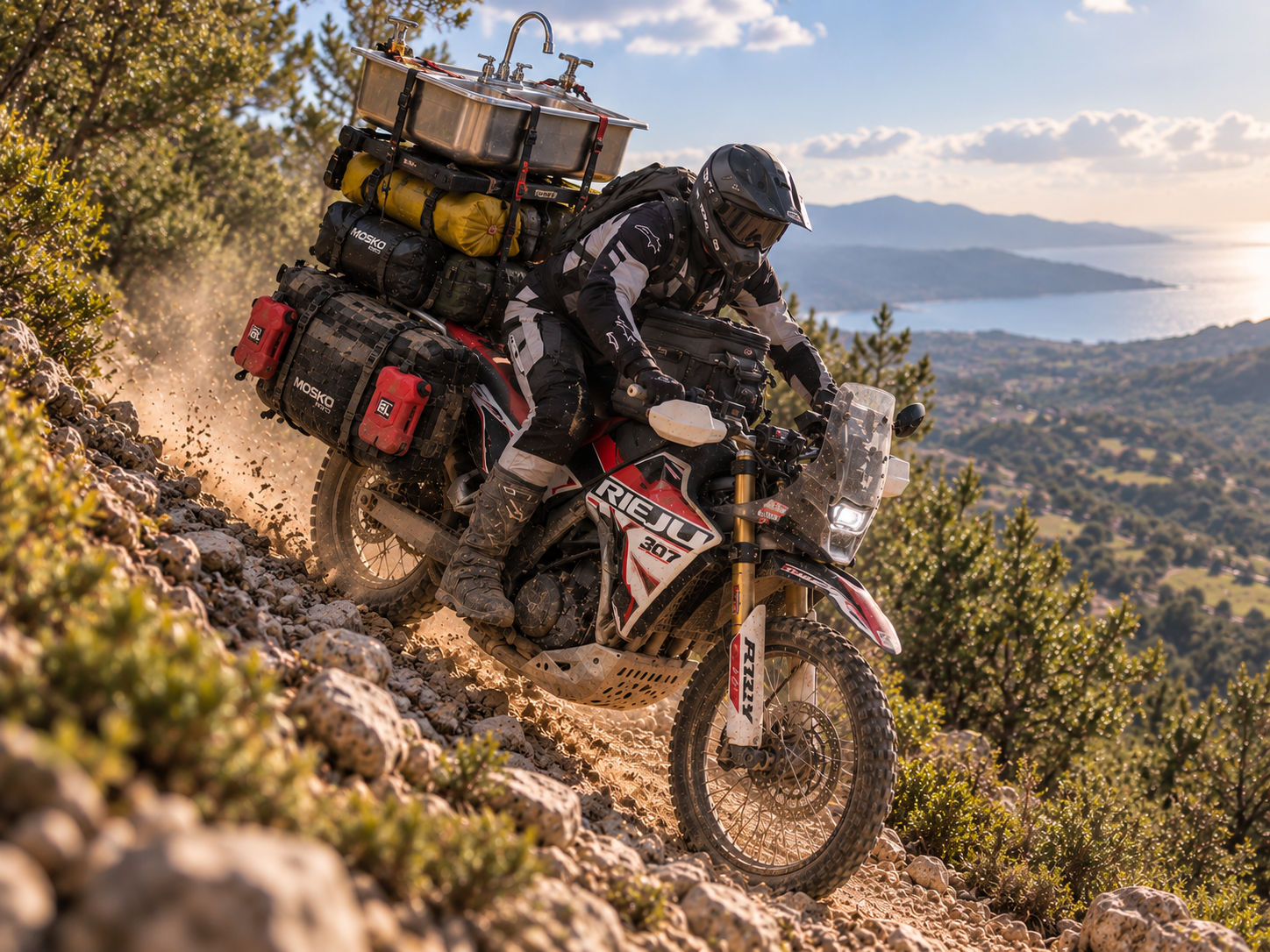
So naturally, being adventure riders, we're now going to completely fuck it up by attaching 47 kilograms of luggage to the back.
Welcome to Part 5.
What actually deserves a place on your motorcycle?
Somewhere along the way, adventure motorcycling seems to have acquired the idea that being prepared means carrying enough equipment to mount a small military expedition. Tools, tubes, compressors, jump packs, first-aid kits, water, food, camping equipment, spare clothes, power banks, cables, security, recovery gear, spare parts — plus a mysterious collection of things that have lived in the bottom of your pannier for four years because one day, possibly, they might become useful.
You know, I used to go into my father's workshop and open his floor-to-ceiling apothecary drawers and find things like 1950s Bakelite plugs. He used to exclaim that you never know when you might need one...
In 2007!
So I've been able to draw this comparison for many decades now.
There is nothing wrong with being prepared. I rather like being prepared. But every single thing you put on the motorcycle has a cost in weight, space and complexity.
And eventually weight equals less fun.
I'm rather more attached to fun than preparedness.
Eventually, the motorcycle you've spent four articles carefully setting up handles like a pregnant yak. It's going to nourish you, but by crikey make sure it doesn't lie on top of you!
So we're going to apply the same rule we've used throughout this series:
What problem are we actually trying to solve?
Start With the Adventure
Before packing anything, there's a question that seems so obvious we often forget to ask it:
Where am I actually going?
A Sunday riding a trail 30 km from home does not require the same equipment as three days crossing remote mountains. A hotel-to-hotel road tour doesn't require camping equipment. A supported group ride doesn't require the same recovery equipment as riding alone. And a route passing through towns every 50 km is very different from disappearing somewhere without fuel, food or phone signal until you realise you missed the next election.
Cyprus isn't Mongolia. Mongolia isn't France. France isn't the Sahara.
There is no universal adventure-bike packing list because there is no universal adventure.
Pack for the ride you're actually doing, not the expedition you've imagined while watching YouTube.
Every Kilogram Has to Earn Its Place
This is perhaps the simplest rule in the article. If something is going onto the motorcycle, ask three questions:
What problem does this solve? How likely am I to have that problem? What happens if I don't have it?
Some items pass immediately. Water? Yes. Puncture repair? Yes. Phone? Obviously. A 14 mm socket required to remove your front wheel? Probably.
A complete ⅜-inch socket set containing seventeen sizes your motorcycle doesn't use?
Why?
That's the distinction we're going to keep making. Preparedness isn't about carrying everything. It's about carrying the right things.
The Toolkit Rule
This is the bit I feel particularly strongly about.
Your trail toolkit shouldn't be capable of dismantling your motorcycle.
It should be capable of getting your motorcycle moving again.
That's a very different objective.
If something goes wrong beside a trail, think about the jobs you're realistically going to attempt. Fix a puncture. Tighten a loose lever or mirror. Adjust a chain. Reattach a handguard. Tighten a battery terminal. Move a control back into position after a crash. Perhaps remove a wheel, change a tube or take off enough bodywork to reach something important.
And, of course, bodge things.
Bodging is a perfectly respectable branch of trailside engineering. The objective isn't to return the motorcycle to showroom condition. It's to make the thing move under its own power until you can get somewhere better equipped to repair it properly.
What aren't you going to do? Rebuild the gearbox, remove the cylinder head, split the crankcases or start re-shimming the valves.
Who's going to check valve clearances on a muddy incline?
Yet look inside some adventure-bike toolkits and you'd think their owner is expecting to perform an engine transplant somewhere outside Samarkand.
Build the Toolkit Backwards
Most people seem to build a toolkit by buying a tool roll, looking around the garage and putting useful-looking things into it. Then they add more tools. Eventually they find an empty pocket, which obviously cannot be tolerated, so they fill that too. Then they watch a YouTube video entitled 17 Tools Every ADV Rider MUST Carry and buy another tool roll.
There is a better way.
Build it backwards from the jobs.
Make a list of the things you're realistically prepared to repair beside a trail, then identify the tools those jobs actually require. That's your starting toolkit.
The question isn't:
What tools could conceivably be useful?
It's:
What jobs am I actually capable of doing here?
Those are very different questions.
Then Do Something Slightly Ridiculous
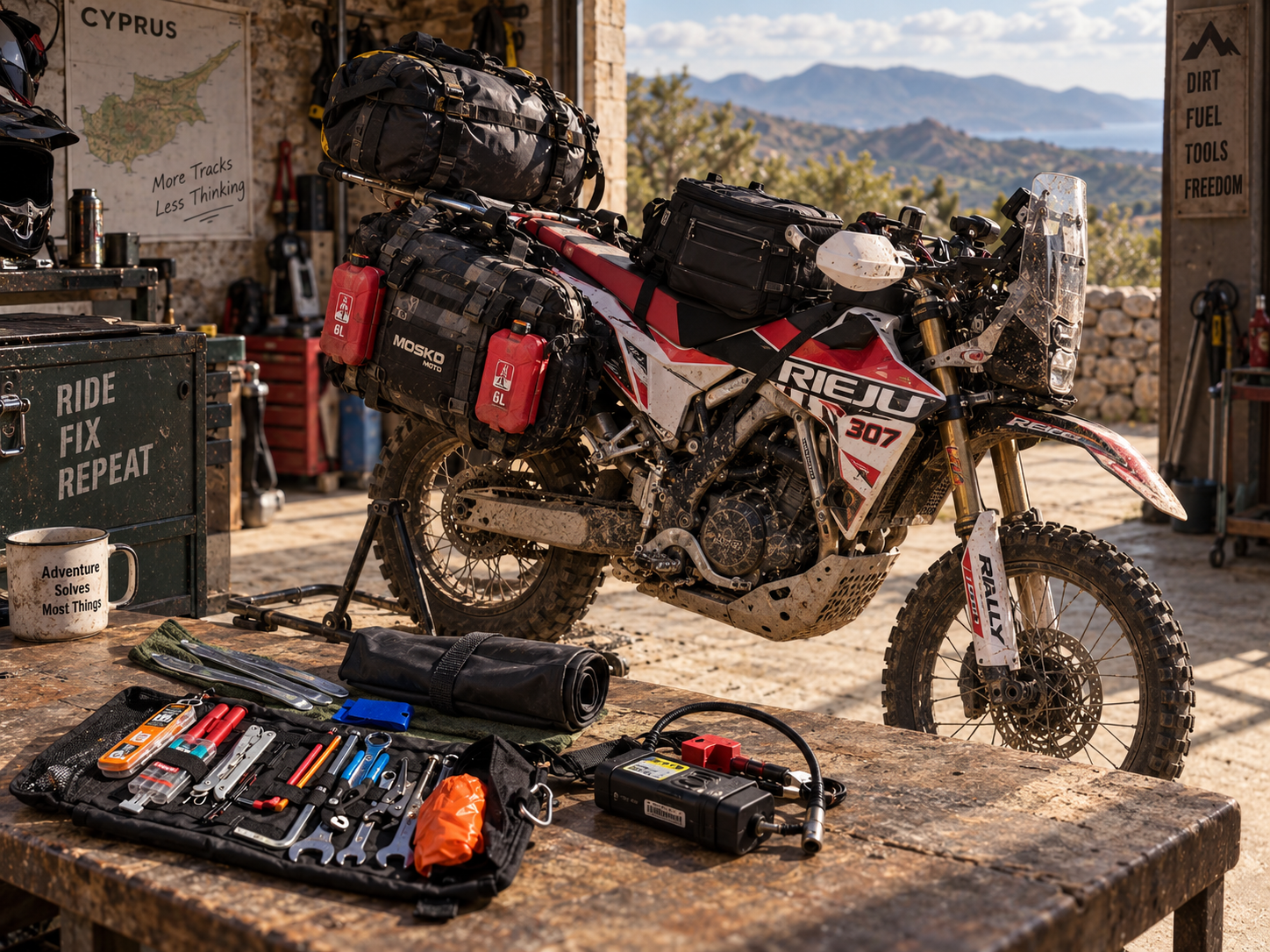
Once you've assembled your trail toolkit, put your workshop toolbox away.
From now on, perform all the routine maintenance on the motorcycle using only the trail toolkit.
Adjust the chain with it. Remove the wheels with it. Adjust the controls with it. Remove the bodywork with it. Access the battery with it. If it's a routine job that you genuinely think you might need to perform away from home, do it using the tools you're actually carrying.
I have genuinely only had to go searching for my full workshop kit once in over a year, and I run a fleet of bikes that get hammered weekly and require a lot of care and detailed attention.
Eventually something wonderful will happen.
You'll reach for a tool.
It isn't there.
Excellent.
You've just discovered a hole in your toolkit while standing in your garage rather than 80 km from the nearest road.
If the missing tool relates to a plausible trailside repair, add it. Then do the job again and prove that your toolkit works.
This is considerably more useful than copying my toolkit, because my motorcycle isn't your motorcycle.
Sound familiar?
The Rainbow Torx Set
I own a lovely set of long rainbow-coloured Torx keys. They're beautiful.
Workshop meets Pride rally.
There are loads of them.
And on our Riejus, for almost everything I'm realistically going to dismantle beside a trail, I need approximately two:
T25 and T30.
So how many Torx keys go into the trail roll?
Two.
Not the whole bloody rainbow.
The other sizes can remain at home looking fabulous.
This sounds almost comically obvious, but repeat that process across sockets, Allen keys, Torx bits and spanners and suddenly your toolkit weighs half as much.
One Tool Doing Three Jobs Is Better Than Three Tools
This is where tool selection becomes fun. A tiny ratchet with interchangeable bits might replace several screwdrivers. A compact bit holder can carry Allen, Torx and screwdriver bits without requiring separate handles for everything. Your axle tool might incorporate another useful size. A decent pair of combination pliers can perform several jobs.
Even a small adjustable spanner can earn its place if it replaces a couple of fixed sizes that are rarely required.
I can hear the howls of indignation from the purists who despise the idea of an adjustable spanner, but watch them change their tune if I give them a choice between carrying a full set of spanners or their fags and booze!
But don't take this too far.
A multitool that theoretically performs seventeen functions but is absolutely horrible at all seventeen isn't necessarily an improvement.
We're looking for tools that are small, light, reliable and actually usable with cold, muddy hands.
Not merely clever.
Consumables Are Often More Useful Than Tools
Here's the slightly ironic bit: some of the most useful things in your toolkit aren't tools at all.
Cable ties in several sizes. Electrical tape. Duct tape wound around a spanner rather than carrying an enormous roll. Spare fuses. A little electrical wire and a few suitable connectors. Safety wire. A couple of bolts or fasteners that your particular motorcycle has demonstrated an enthusiasm for losing. A chain master link appropriate to your actual chain. Perhaps some hose.
A small travel chain lube covers the chain, and a tiny bottle of shampoo gives you something slippery for the tyre bead when you're wrestling with a tube.
These things weigh almost nothing, yet they're exactly the sort of things that can turn:
We're stuck.
into:
That's horrible, but it'll get us home.
Trailside engineering is not concours restoration.
If the handguard is attached with three cable ties and optimism when you arrive home, it has succeeded.
Punctures Deserve Their Own Plan
A puncture is not some bizarre theoretical failure. If you ride off road for long enough, you're going to get one.
I've had millions.
The most important thing to carry then is a brew stove.
Chill out. Have a cuppa. Have a think. Don't rush. Take the pressure off.
So your puncture strategy should not begin when you hear:
Pssssssssss.
What tyres are you actually running? Tubed? Tubeless? Tubliss? Mousses?
Each requires a different answer.
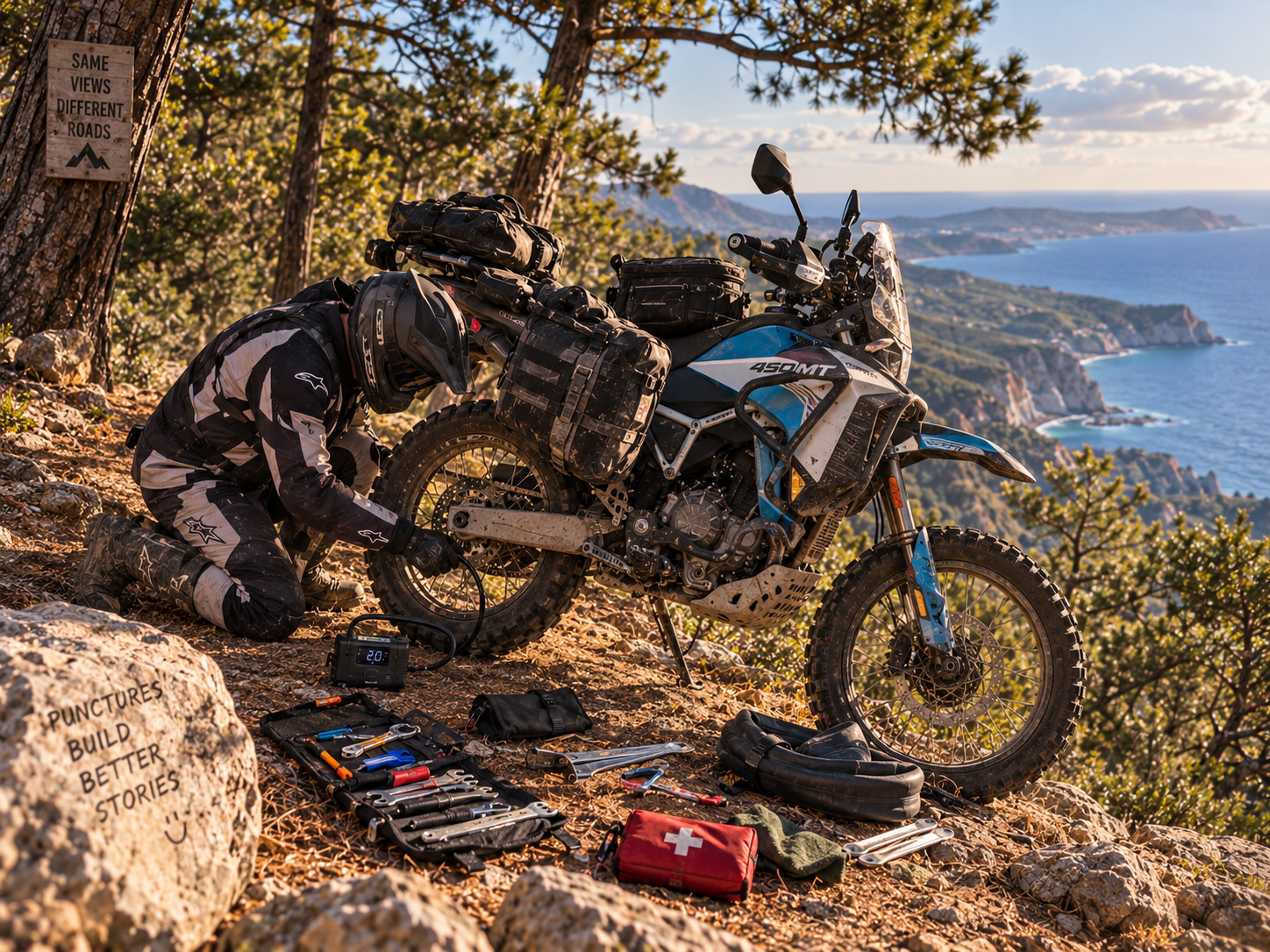
For a tubeless tyre, that might mean plugs, insertion tools and a compressor. For a tubed wheel, a plug kit is approximately as useful as a chocolate teapot. You may need tubes, tyre levers and the tools required to remove the wheel.
And here's another reason to test your toolkit at home:
Can you actually remove both wheels using only what's on the motorcycle?
Have you tried?
Because discovering that your beautifully curated tool roll doesn't contain the one enormous hex required to remove the front axle is much funnier in your garage than halfway up a mountain.
I carry a valve puller tool, for instance. I put one in every toolkit we issue.
Why?
It saves grazed knuckles and obscenities that would curl the toes of an inner-city hooker.
That's why.
Inflation
If your puncture strategy involves deflating or repairing a tyre, you need some means of removing air or putting air back into it.
I have a very simple valve-core remover attached to the keyring of each bike. You can't lose it.
I'm also a fan of compact electric compressors. They're small, easy and, after you've just fought a tyre beside a trail in 32-degree heat, the romance of manually pumping 30 psi into an adventure-bike tyre disappears remarkably quickly.
Whatever you choose, test it.
Actually inflate a tyre with it.
Don't simply confirm that the little LED comes on and conclude that you're ready for Dakar.
Spares: Carry the Things That Can Actually End Your Day
This is where people can go completely mad.
A spare motorcycle is undoubtedly useful. It is also quite difficult to strap to the rear rack.
So once again, ask two questions:
What can realistically fail?
And:
Can I actually replace it beside the trail?
A spare lever might make sense. A clutch cable on a cable-operated bike might make sense, particularly if the existing one has an interesting history. Fuses weigh virtually nothing. A chain master link weighs almost nothing. A few bike-specific fasteners might be worthwhile.
Our Riejus are remarkable. You can rebuild about 80% of the bike with two types of fastener. Someone in that design department deserves a medal!
If your motorcycle has a known vulnerable component that is small, light and genuinely replaceable trailside, perhaps carry one.
On any long-distance journey I do, I carry a regulator/rectifier. It's small enough to carry, capable of ending the trip if it fails, and something I can actually replace myself.
For Horizon Rider I just have one in the workshop. If one goes bang, I'll ride it out to you.
But carrying a spare component without the tools or knowledge required to fit it is merely transporting motorcycle parts around the countryside.
First Aid Is Different
I'm going to separate first aid from the normal weight argument because we're no longer talking about whether the motorcycle gets home.
We're talking about whether you do.
Carry a sensible first-aid kit and, more importantly, know what's in it. A first-aid kit sealed in plastic that you've never opened is considerably less useful than you might imagine.
You don't need to build an operating theatre, but you should be able to deal with the sort of injuries reasonably associated with riding motorcycles away from immediate help.
And ideally, get some training.
My sailing qualifications mean I've repeatedly had to do fairly serious first-aid training — heart attacks, major bleeding, fractures, shock and all the unpleasant things you'd rather never encounter.
Likely you haven't, but you should know what to do if Dave, your best mate for 40 years, keels over with a heart attack. There's a proper process to follow and Dave might just thank you the following Christmas rather than you gazing at the star he's become.
The best medical equipment you carry weighs nothing.
It's the bit between your ears.
Water Isn't Optional
Motorcycles can continue riding when you're thirsty.
Unfortunately, riders become increasingly stupid.
Dehydration affects concentration and decision-making long before you dramatically collapse beneath a cactus. So carry enough water for the conditions — not enough for the photograph, enough for the ride.
Hot climate? Carry more. Remote route? Carry a reserve.
In July and August here I carry a 2 L backpack bladder plus 2 × 1 L bottles in my luggage. I also keep a tube of salt-based electrolytes in there too. You'd be amazed how that revives groggy fainters!
And remember that water is heavy.
One litre is exactly one kilogram.
That doesn't mean don't carry it. It means recognise it as part of your load and put it somewhere sensible.
Where You Put Weight Matters
Five kilograms isn't simply five kilograms.
Five kilograms low and central on the motorcycle is very different from five kilograms perched high behind the rear axle. Adventure riders have an extraordinary talent for carefully centralising the motorcycle's mass and then attaching a small block of flats to the luggage rack.
Heavy items should generally go low, central and secure.
Tools are heavy. Water is heavy. Spares can be heavy. Try not to stack all of them in the penthouse.
The further rearward and higher you put weight, the more you'll feel it — particularly when standing, particularly in slow terrain and particularly the first time the motorcycle decides to have a little lie down.
And there's another reason this matters.
Remember sag?
Of course you bloody do.
We've just spent four articles carefully setting up the motorcycle and its suspension. I was rude to you back then for not doing something about it and now you know, I'm going to be that grumpy bastard who's like a dog with a bone.
Dumping a large amount of weight way behind the rear axle changes the load on the rear suspension and changes the motorcycle's attitude again.
Your luggage isn't merely something the engine has to carry.
The suspension has to control it.
Soft Luggage or Hard Luggage?
Here we go.
Another subject upon which the internet has behaved completely normally.
Hard panniers are excellent at some things. They're secure, convenient, easy to organise, often waterproof and superb for road touring.
I've owned a set.
I sold them because they really injured my leg in a fall at maybe 5 km/h.
Soft luggage is excellent at other things. It's lighter, usually narrower, more forgiving in a fall and rather less likely to trap your leg between an aluminium box and planet Earth.
Which one is correct?
What are you doing?
For predominantly road travel, hard luggage may make perfect sense. For technical off-road riding, I strongly prefer soft luggage.
That's not a universal law.
It's my answer to my riding.
There's that irritating theme again.
Waterproof Means Waterproof
If your luggage isn't genuinely waterproof, put the things that need to remain dry inside dry bags.
Do not trust the phrase:
Water resistant.
Water resistant is an extremely useful marketing property right up until it rains.
Sleeping bags, warm clothing, electronics and documents all deserve particular attention. Anything whose failure to remain dry will materially ruin your day should get another layer of protection.
A wet sleeping bag at the end of a miserable day is an excellent way to curse your life choices.
Navigation and Power
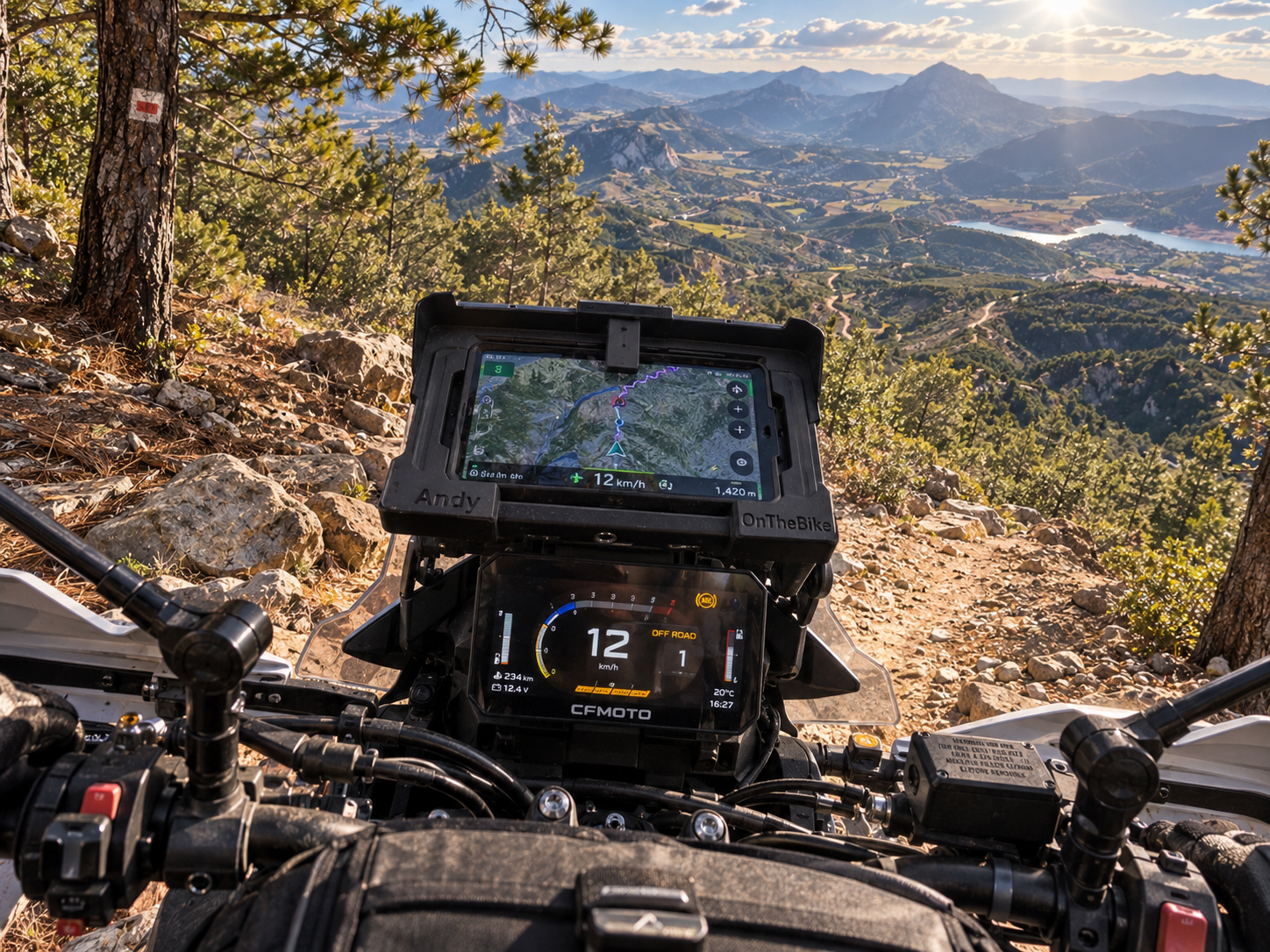
For most of us, navigation now means electronics. Phone, dedicated nav device, GPS — whatever.
As I said, I've been a captain of large sailing boats for more years than I can remember, so I can navigate by the stars or triangulate a three-position fix from a chart without a blink.
But I don't.
Because... well, you know why.
Life has moved on. Maps on electronic devices are simply better and easier, and at worst I have two or three devices on a trip.
But if your navigation depends on electricity, your plan needs to include electricity.
Bike power is excellent, but don't make one cable your single point of failure. I like having navigation powered from the motorcycle with enough independent battery capacity to keep something alive if the bike supply fails.
My primary navigation device has a huge battery of its own. I can navigate for three days with zero top-up.
And still carry the cable that actually fits the bloody device.
Not the remarkably similar one you accidentally packed.
Ask me how I know.
Your Phone Is Also Safety Equipment
Maps, emergency calls, location sharing, weather, accommodation, translation, torch, camera, documents — your phone does rather a lot.
Which is exactly why relying on it for absolutely everything creates another single point of failure.
Lose it. Break it. Drown it. Flatten the battery.
Now what?
I'm not suggesting you carry a satellite communications centre on every Sunday ride. I'm suggesting you understand what disappears when your phone does.
For genuinely remote travel, some form of independent emergency communication may deserve serious consideration.
Again:
Where are you actually going?
Security
A security device is useless if it's so enormous that you stop carrying it. Equally, a tiny deterrent may not achieve very much.
For travel, I want something practical enough that I'll actually use it. A disc lock. An alarm. A physical lock where appropriate. And if the motorcycle has tracking, excellent.
None of these makes a motorcycle impossible to steal.
We're increasing inconvenience.
We're encouraging a thief to say, “Blimey, I'll steal the bike next door instead.”
Adventure travel is already full of compromises.
Here's another one.
Recovery Gear
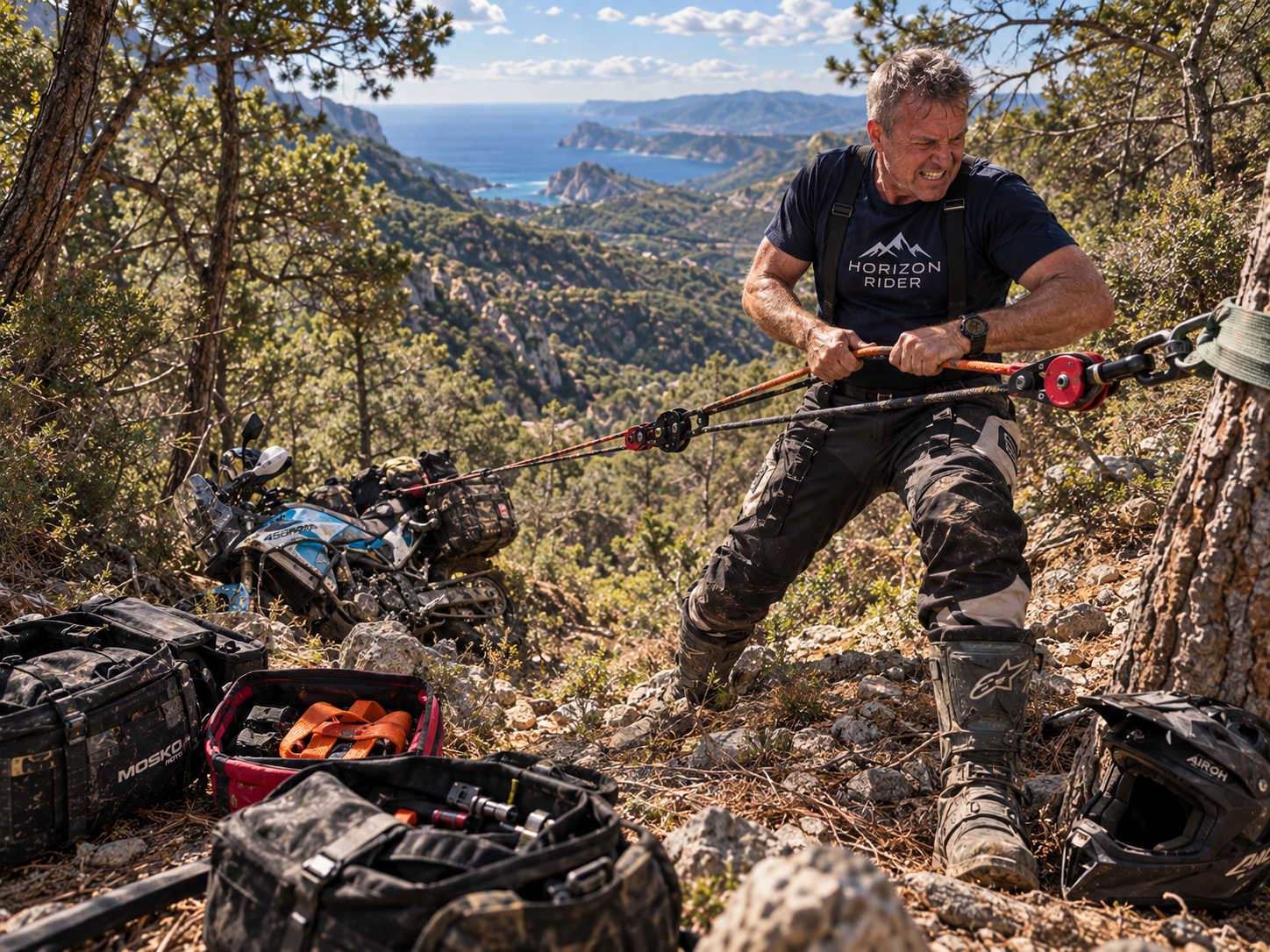
This is an interesting category because its value changes enormously depending on whether you're alone.
A tow strap can be remarkably useful. So can a small length of strong cord. But once again, ask what you're actually capable of doing with it.
If you're travelling with another motorcycle, a tow strap has an obvious second end. Personally, I carry 30 m of high-strength paracord. You can double or triple it to give you enough pull strength.
If you're alone in a ravine, it's mainly an attractive strap.
The best recovery tool may sometimes be:
Another human being.
Choose your adventures accordingly.
Camping Equipment: Now the Weight Really Starts
Camping is where a beautifully light adventure bike can gain the mass of a small moon.
Tent, sleeping bag, mat, pillow, stove, fuel, cooking equipment, food, chair, clothes, warm layers — and suddenly you've recreated your bedroom and kitchen on the rear mudguard.
My rule here is exactly the same:
What problem does this solve, and is there a lighter way of solving it?
That does not mean buying £700 titanium everything.
Comfort matters. Sleep matters. Being warm matters. A miserable rider makes bad decisions.
But there is a difference between comfortable camping and transporting your house.
The Chair Question
I know somebody is going to ask.
Yes.
Take the chair if sitting comfortably at the end of the day materially improves your trip.
This isn't an ultralight backpacking competition. We're not weighing toothbrush handles and weighing up the worth of sawing one in half.
The point isn't:
Carry as little as physically possible.
The point is:
Understand why you're carrying each thing.
If your chair earns its place every evening, it earns its place.
If you've carried a frying pan around Europe for three weeks and never used it, perhaps the frying pan has failed its annual appraisal.
Clothing: You're Going to Smell
There.
I've saved you an entire pannier.
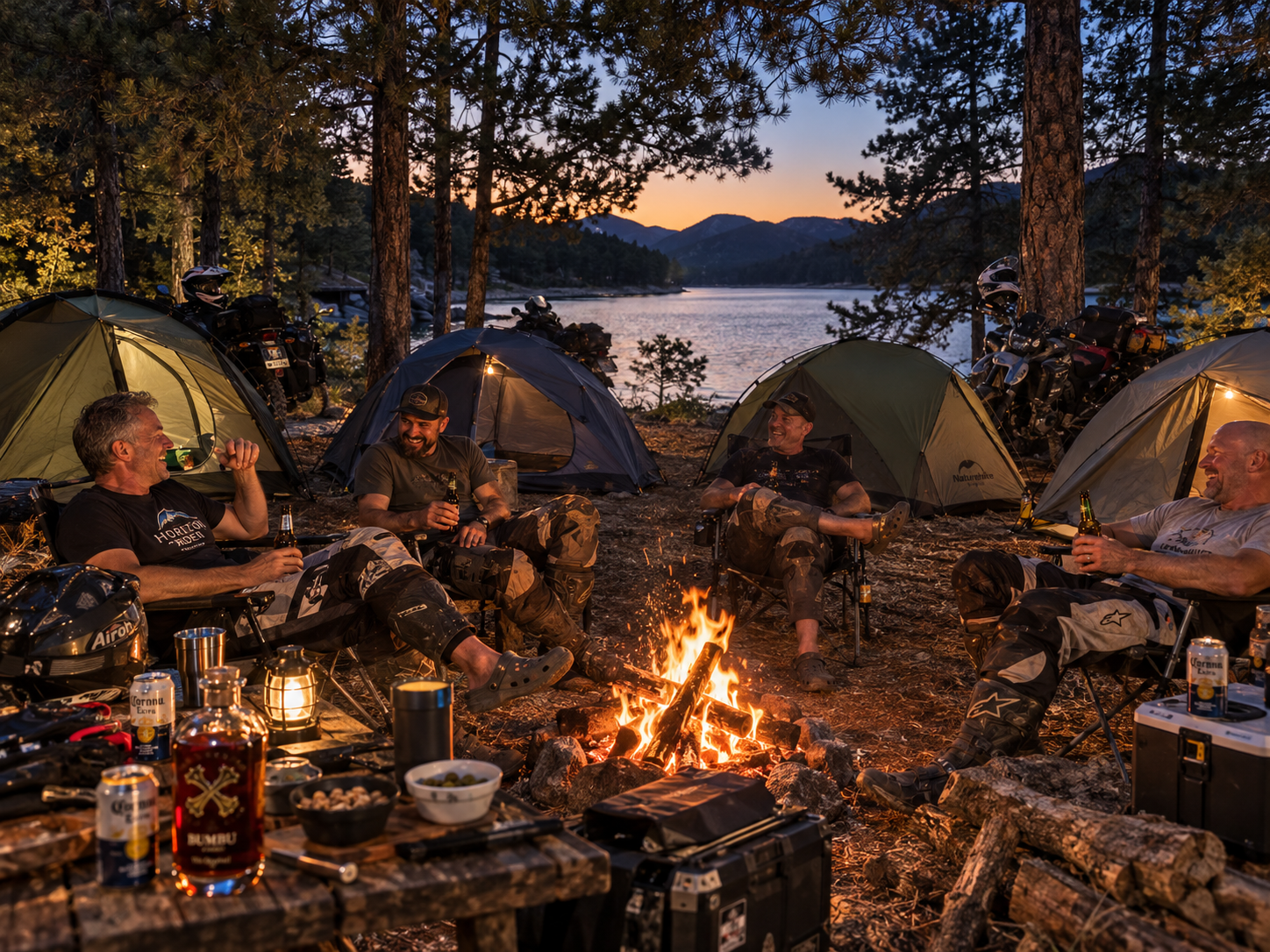
You do not need clean clothes for every day of a two-week motorcycle trip. Nobody expects you to smell like the perfume department at Harrods after eight hours in motorcycle gear.
Take layers. Take things that dry quickly. Wash stuff. Reuse stuff. Use Merino wool base layers that somehow don't smell. I dunno, I've never caught and smelled a Merino, but I know it works!
Possum fur is much the same. It's bloody expensive but it's bloody aroma-free.
Failing that, put the campfire chairs an extra pace backwards.
It'll be fine.
And accept that after several days everybody smells romantically agricultural.
That's adventure.
Don't Pack Your Fears
This might be the most important packing rule of all.
People often pack for things they're frightened might happen rather than things that are reasonably likely to happen.
What if I need this? What if that breaks? What if it's cold? What if it's hot? What if I get stranded? What if there's no food?
Keep following that logic and eventually you'll need a support truck.
Risk management isn't eliminating every possible problem.
It's deciding which problems deserve preparation.
That's as true for motorcycles as it was for everything else in this series.
The Post-Trip Audit
Here's how your loadout actually gets good.
When you get home, unpack the motorcycle and make three piles:
Used.
Didn't use, but would never travel without. It's the insurance.
Why the hell did I bring this?
The middle category matters.
You may not use your first-aid kit. Excellent. Keep carrying it.
You may not use your puncture kit. Excellent. Keep carrying that too.
But the fourth spare T-shirt? The enormous knife? Three different power banks? The cooking pan you never touched? The backup backup torch? The emergency folding shovel because apparently we're invading Belgium?
Now we're learning.
Do this after every significant trip and your loadout evolves.
There's another useful version of this exercise you can do before the next trip. Lay everything you're planning to take on the floor before putting any of it into the luggage.
Actually look at it.
Then pick up every item individually and ask:
Why are you coming?
If you can't give it a convincing answer, it may not deserve a ride.
My Loadout Isn't Your Loadout
You knew this section was coming.
I can show you exactly what I carry.
And I probably will. If you come to Horizon Rider, you'll see it first hand.
But copying it would miss the point.
Different bike. Different route. Different climate. Different accommodation. Different mechanical ability. Different appetite for risk.
Different tolerance for smelling agricultural.
The useful part isn't my list.
It's why each thing is on it.
If you understand that, you can build yours.
What Actually Deserves a Place on Your Motorcycle?
So that's Stage 5.
We began with a standard motorcycle and progressively asked it some questions.
Stage 1: Put the motorcycle where it should be.
Sag.
Stage 2: Put the rider where they should be.
Ergonomics.
Stage 3: Put the engine where you need it.
Gearing.
Stage 4: Tell the suspension how to behave.
Damping.
And now:
Stage 5: Only put on the motorcycle what the adventure actually needs.
Loadout.
There isn't a perfect packing list.
There isn't a perfect toolkit.
There isn't a correct number of litres of luggage.
There's simply a motorcycle, a rider and an adventure.
Work out what that adventure genuinely requires, carry the things that solve those problems, and leave the rest at home.
Because every kilogram you don't carry is a kilogram you don't have to accelerate, brake, steer, pick up or extract from a Cypriot ravine.
And if, halfway through packing, you find yourself wondering whether you should take the tool required to check your valve clearances...
You already know the answer.
You're not checking the bloody valve clearances on a muddy incline.
