
Part 3 —gearing Changes the Character of Your Bike
Gearing: Put the Engine Where You Need It
In Part 1 we put the motorcycle where it should be.
In Part 2 we put the rider where they should be.
So now we have a properly suspended motorcycle, with its rider sitting and standing in roughly the right place.
Excellent.
There's just one problem.
The engine is still operating wherever the manufacturer decided to put it.
Not physically. Please don't reach for the angle grinder.
I'm talking about gearing.
And gearing is one of those subjects that manages to be both incredibly simple and unnecessarily complicated at the same time.
Mention changing sprockets on a motorcycle forum and within twenty minutes somebody will have produced a spreadsheet containing primary drive ratios, individual gearbox ratios, tyre rolling circumferences and enough decimal places to navigate a spacecraft to Mars.
All useful stuff.
But for most of us, the question is considerably simpler:
What do I want the motorcycle to do better?
Because two relatively inexpensive lumps of metal can dramatically alter the way a motorcycle feels.
And sometimes, when riders say they want more power, what they actually want is different gearing.
First, the Very Simple Bit
Your engine turns.
That rotation passes through the gearbox, turns the front sprocket, pulls the chain and turns the rear sprocket.
For this article, we're interested in the last two.
The front sprocket.
And the rear sprocket.
Let's imagine your bike has:
15 teeth at the front.
45 teeth at the rear.
We can describe that as:
15/45
Divide 45 by 15 and we get a final-drive ratio of:
3.00
You absolutely do not need to remember that number.
What matters is what happens when we change either sprocket.
Fit a smaller front sprocket or a larger rear sprocket, and you make the gearing shorter.
Fit a larger front sprocket or a smaller rear sprocket, and you make the gearing taller.
That's basically the entire theory.
Unfortunately, we should probably explain what those words actually mean.
Shorter Gearing
Let's make the rear sprocket bigger.
The engine now has to turn more times to produce the same number of rear-wheel revolutions.
So, at any given road speed, the engine is running at higher RPM.
What do we get in return?
More mechanical advantage at the rear wheel.
The bike feels more eager.
It accelerates more readily.
It will crawl more slowly in first gear for a given engine speed.
Technical climbs become easier.
You can often use a higher gear through slow terrain.
And the engine is more likely to be sitting in the useful part of its power and torque range when you ask it to do something.
There is, of course, no free lunch.
At motorway speeds the engine will also be spinning faster.
That can mean more vibration, more noise and potentially more fuel consumption.
You'll also reach any given RPM at a lower road speed.
In simple terms:
Short gearing trades road speed per engine revolution for greater leverage at the rear wheel.
Which sounds suspiciously like something we might want off road.
Taller Gearing
Now let's go the other way.
Larger front sprocket.
Smaller rear sprocket.
At any given road speed the engine turns more slowly.
The bike becomes more relaxed at cruising speeds.
Each gear covers a greater range of road speed.
Motorway RPM drops.
Potentially, so do vibration and fuel consumption.
Lovely.
But again, we've traded something.
First gear is now taller too.
The engine has less mechanical advantage at the rear wheel.
At very low speeds you may need more clutch.
Steep technical climbs may require more commitment.
And if you go too far, you can actually make top gear less useful, because the engine no longer has enough grunt at the resulting RPM to pull it properly.
That last bit is important.
Taller gearing does not magically give your motorcycle a higher top speed.
It gives the motorcycle the potential to travel further for each engine revolution.
Whether the engine has enough power to overcome aerodynamic drag and actually achieve that speed is an entirely different matter.
So Which Is Better?
Neither.
That would be a rather short article.
The question is:
Better for what?
If I'm spending the day picking my way through rocky climbs, loose switchbacks and slow technical trails, I want very different gearing from somebody crossing France on a motorway.
And here's where our example CFMOTO 450MT becomes rather useful.
Because I've tried both.
At opposite ends of the same motorcycle.
One Bike. Two Personalities.
The standard 450MT gearing is 14/47.
It's a pretty sensible compromise.
Which is exactly what you'd expect.
Manufacturers have to produce one motorcycle that can leave a showroom and cope reasonably well with commuting, motorways, back roads, pillions, luggage and some dirt.
I don't have to do that.
I know what I'm using the motorcycle for.
And more importantly, I can change it.
For our dirt-biased 450MT setup, I've used:
14/50
For the road/touring setup:
15/45
Same engine.
Same gearbox.
Same motorcycle.
Very different result.
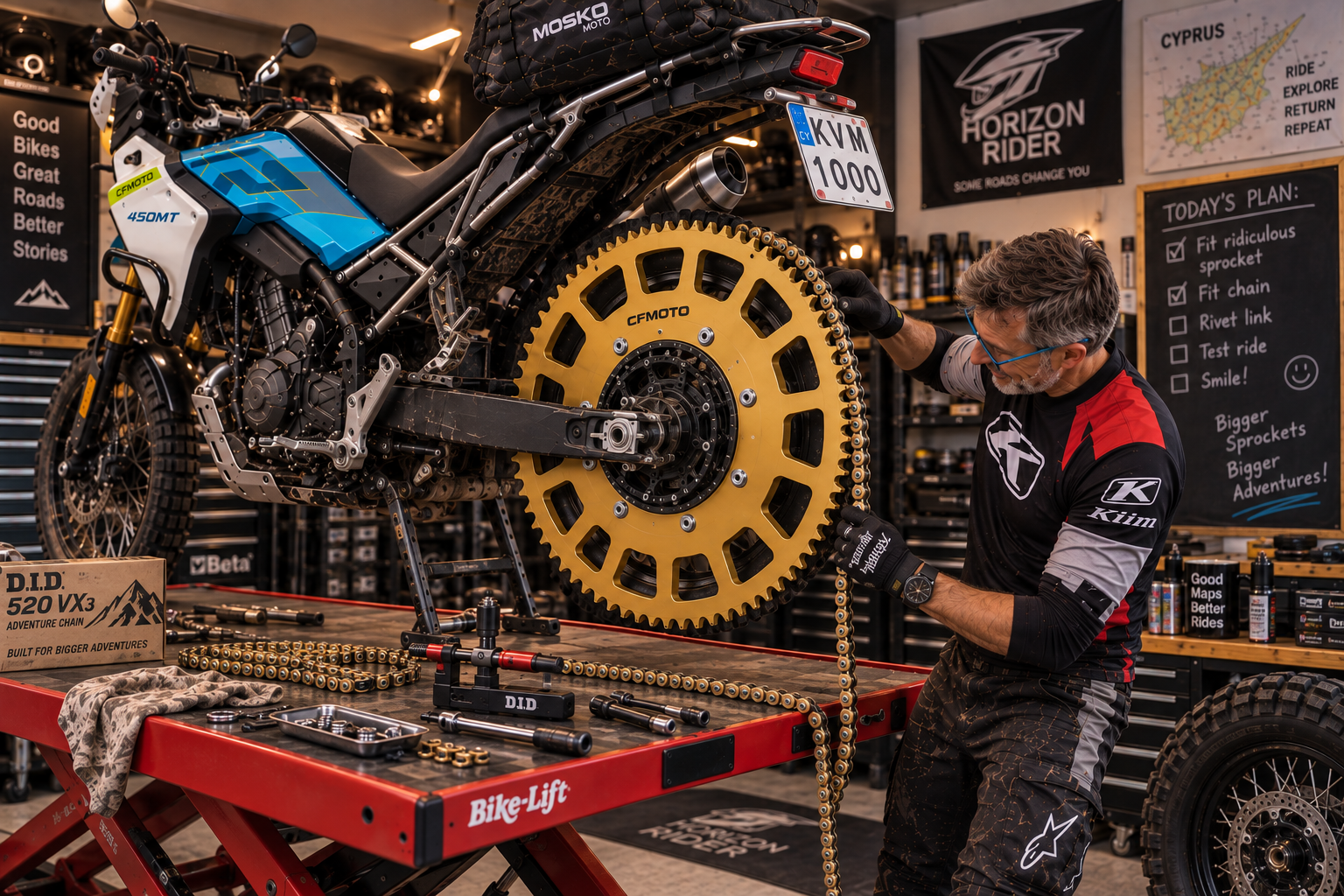
14/50 — Put the Engine in the Dirt
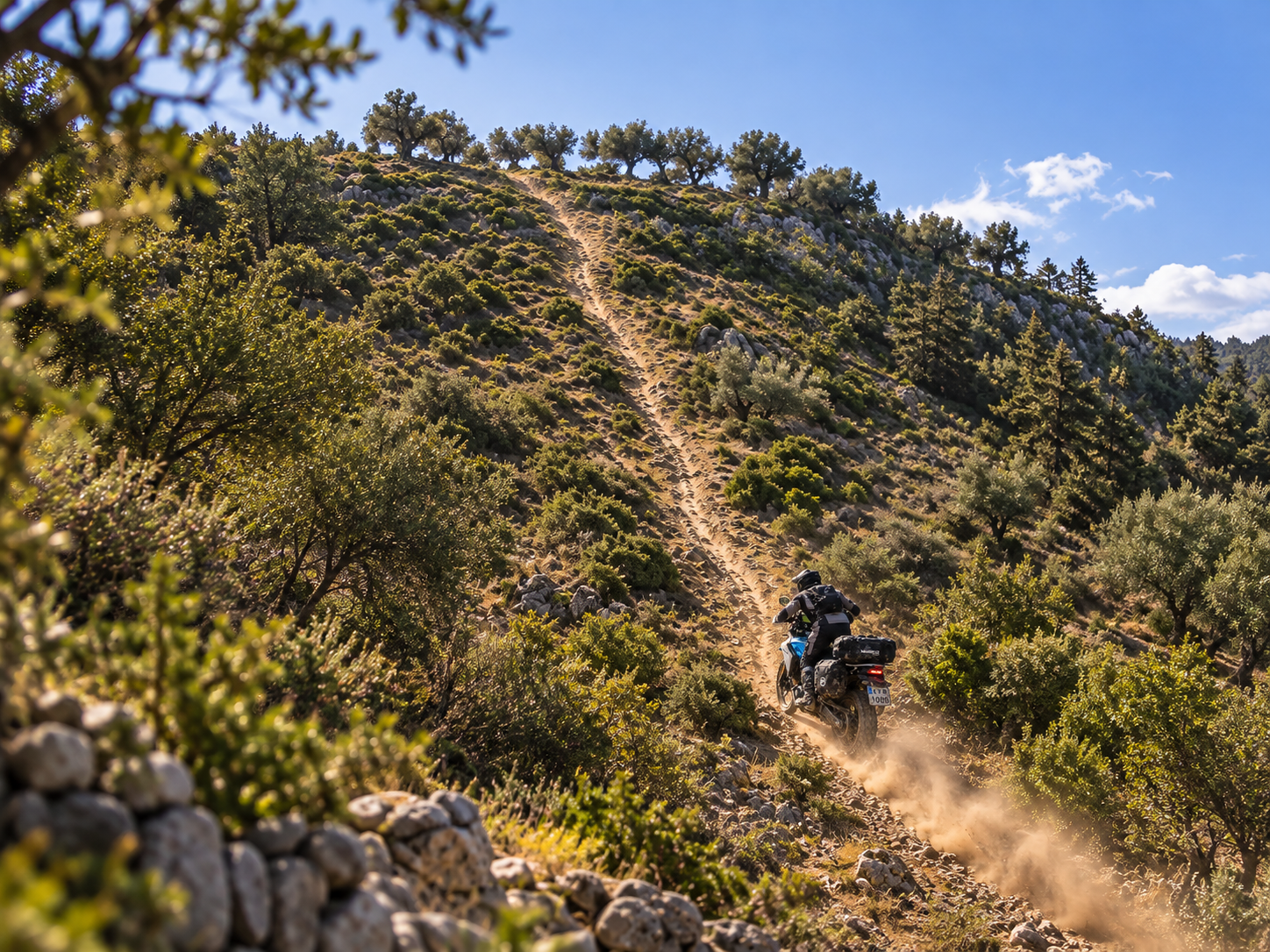
Let's start with the dirt setup.
Going from the standard 47-tooth rear sprocket to a 50 while retaining the 14-tooth front shortens the final gearing.
The difference on paper doesn't look enormous.
On a trail, you notice it immediately.
First gear becomes more useful at genuinely slow speeds.
The bike is happier crawling.
You don't need to abuse the clutch quite as much to keep the engine where you want it.
Second gear becomes useful in places where you might previously have dropped into first.
On climbs, the engine gets into its useful operating range sooner.
And when you close the throttle, you get more engine braking at the rear wheel for a given road speed.
None of this has added a single horsepower.
The engine hasn't become more powerful.
We've simply changed the leverage between the engine and the rear tyre.
And that's why gearing can be such a transformative modification.
Sometimes what feels like an engine problem isn't an engine problem at all.
“I Need More Power”
Do you?
Perhaps you do.
I'm certainly not going to campaign against horsepower. That would be hypocritical.
But imagine you're riding a trail and your motorcycle feels flat.
You open the throttle and nothing particularly exciting happens.
You find yourself slipping the clutch to get through slower sections.
On climbs, the engine keeps falling below the bit of the rev range where it actually does anything useful.
The obvious conclusion is:
I need more power.
Maybe.
But before buying an exhaust, intake, ECU tune and that collection of stickers that definitely adds at least 17 bhp, ask another question:
Is the engine simply in the wrong gear ratio for what I'm asking it to do?
Shorter gearing doesn't increase engine output.
What it does is give you more torque multiplication at the rear wheel and allows the engine to reach its useful rev range at a lower road speed.
From the saddle, that can feel remarkably like you've made the motorcycle more powerful.
You haven't.
You've made the power you already had easier to use.
That's a very different thing.
15/45 — Now Let's Go Somewhere
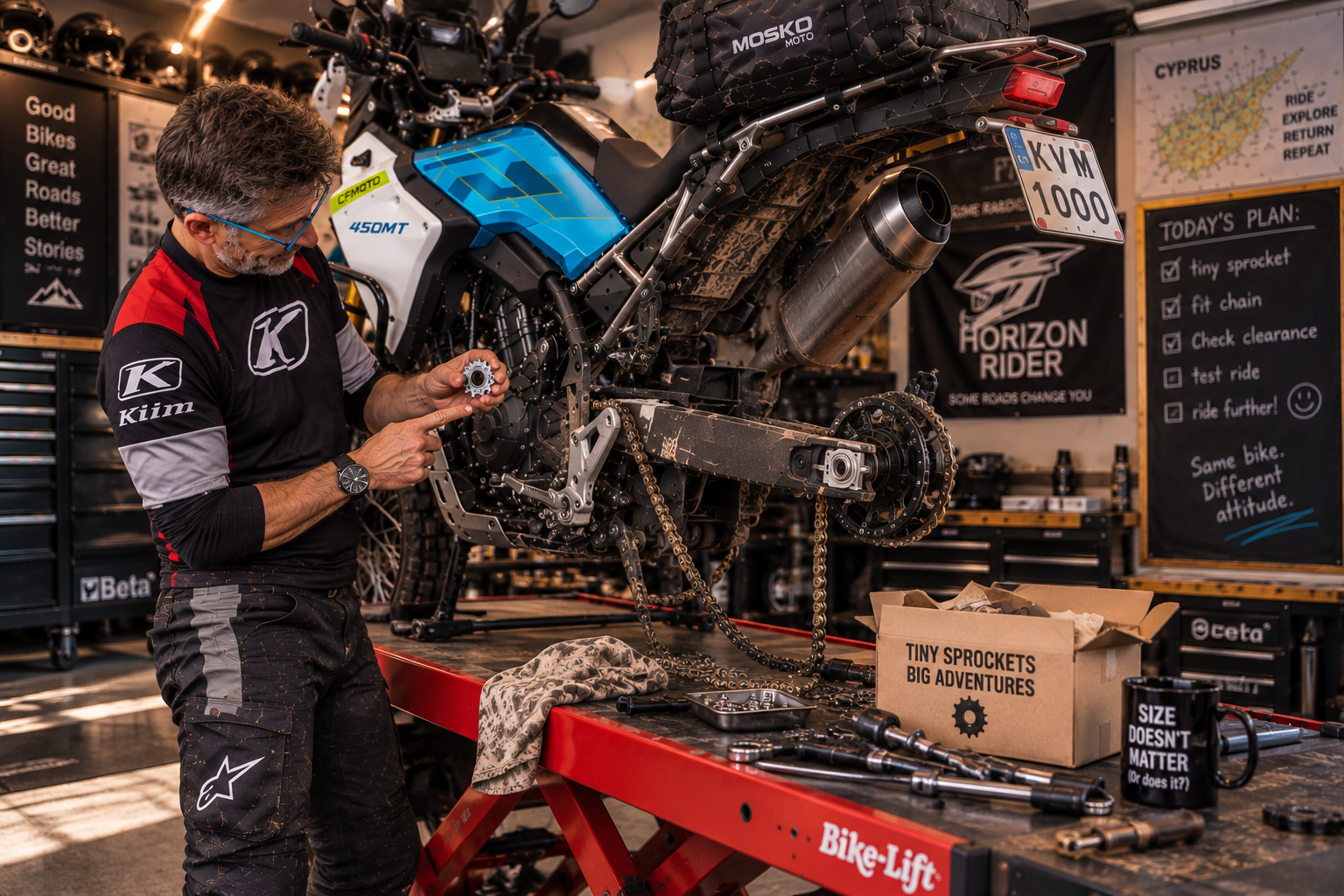
At the other end of the spectrum is my road setup.
15 teeth at the front.
45 at the rear.
This is considerably taller than 14/50.
And I fitted it for a completely different job.
Long-distance road travel.
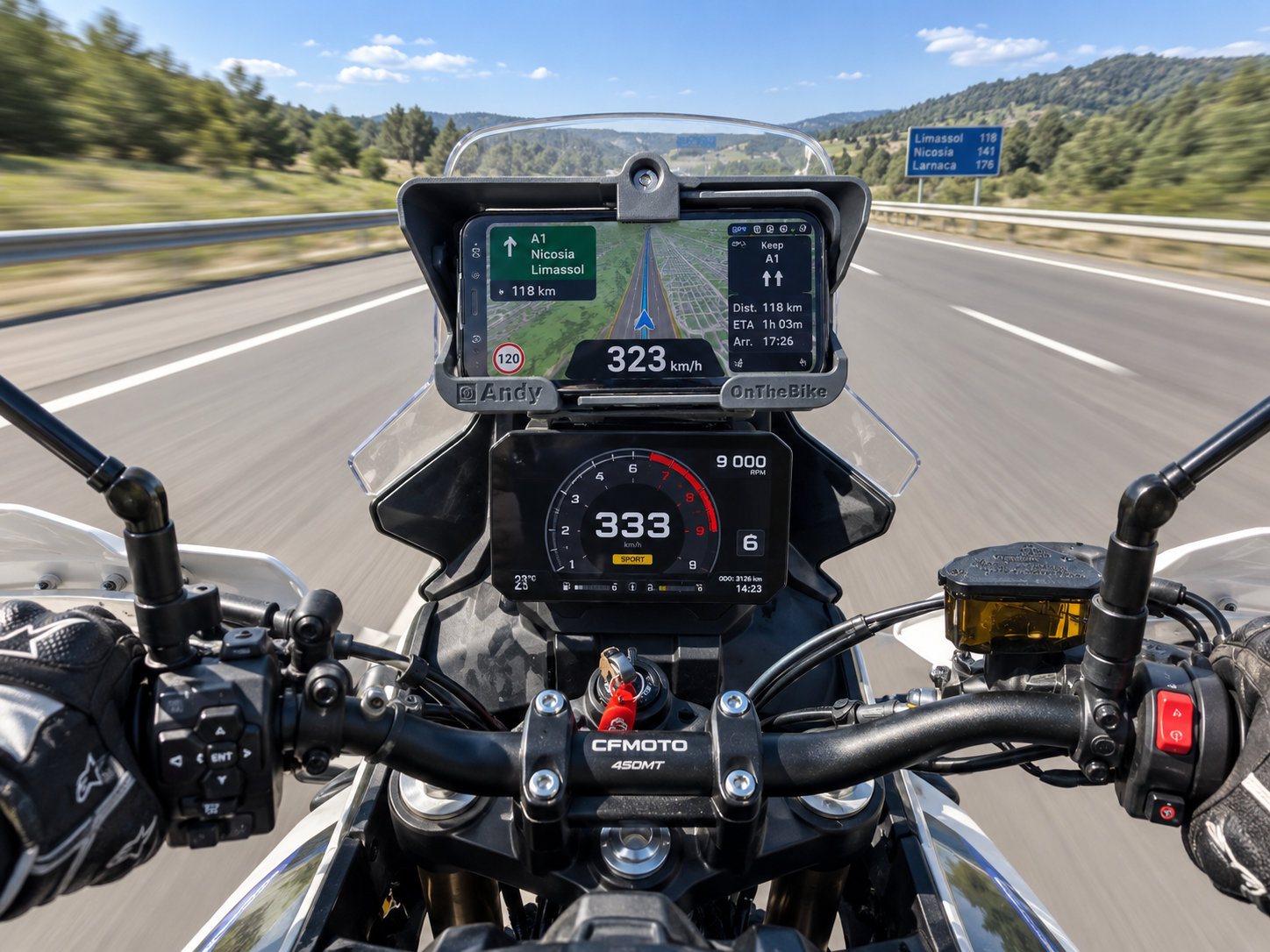
At 70 km/h in sixth gear, the 450MT sits at around 3,500 rpm.
At 80 km/h, around 4,000 rpm.
At 90 km/h, around 4,500 rpm.
At 100 km/h, around 5,100 rpm.
Compared with the shorter gearing I'd been running, that's roughly 770–800 rpm less through much of that useful road-speed range.
That is not a tiny difference.
Sit on a motorcycle for ten minutes and 800 rpm probably doesn't matter.
Sit on it for eight hours and suddenly it matters quite a lot.
The bike feels calmer.
The engine sounds less busy.
There's less sense that it's frantically getting somewhere while you're merely trying to cross a country.
And sixth gear starts behaving much more like a proper cruising gear.
Exactly what I wanted.
And because our 450MTs have been modified with an ECU matched to a performance exhaust, and they have a 70% larger air intake, they've been blessed with a reasonable power increase but also 12% more torque.
The net effect is that we do have the oomph to pull the taller gearing without simply running out of power trying to overcome aerodynamic drag, as I mentioned previously.
Have I Made the Bike Better?
No.
I've made it better at something.
That's a crucial distinction.
If I take my 15/45 road setup onto a horrible rocky climb and then complain that first gear is too tall, I'm an idiot.
The sprockets haven't failed.
I selected the wrong gearing for the job.
Likewise, if I fit 14/50 for technical trails and then spend six hours on a motorway complaining about engine RPM, that's hardly the motorcycle's fault either.
This entire series is really about the same idea:
Set the motorcycle up for the job you're actually asking it to do.
Not the job the manufacturer guessed you might do.
Not the job somebody on YouTube does.
Yours.
And in my case I have an oily cupboard for storage that allows me to have both when I need it.
What About Engine Braking?
Gearing also changes what happens when you close the throttle.
With shorter gearing, the engine has more leverage over the rear wheel.
That means stronger engine braking at a given road speed.
Off road, that can be useful. On steep descents it gives you another tool alongside your brakes. It can help control speed without constantly dragging the rear brake.
But once again, more isn't automatically better.
Too much engine braking on a loose surface can make the rear tyre easier to unsettle.
And some riders simply prefer a freer-running motorcycle.
Gearing changes both sides of the relationship.
The rear wheel doesn't only receive torque from the engine. When you shut the throttle, it sends forces back the other way too.
One Tooth at the Front Is Not the Same as One at the Rear
This catches people out.
Changing one tooth at the front is a much bigger percentage change than changing one tooth at the rear.
Using our 15/45 example, removing one tooth from the front takes us from 15 to 14.
That's a substantial change.
Adding one tooth to the rear takes us from 45 to 46.
Much smaller.
That's why rear sprockets are useful when you want to make finer adjustments.
You'll sometimes hear the rule of thumb that one tooth at the front is worth roughly three at the rear.
It's not universally exact because it depends on the starting sprocket sizes, but it's perfectly useful as a mental shortcut.
There is another reason not to go berserk with tiny front sprockets.
The smaller the front sprocket becomes, the more tightly the chain has to bend around it.
That can increase chain and sprocket wear.
So if you're making a substantial gearing change, don't automatically assume the front sprocket is the best place to do all of it.
Your Chain May Have an Opinion
Unfortunately, sprockets don't exist in isolation.
Your chain has to fit around them.
A modest sprocket change may work perfectly well with your existing chain and available axle adjustment.
A large change may not.
Fit a much larger rear sprocket and you may need a longer chain.
Fit a much smaller one and you may find you've run out of adjustment in the other direction.
The rear wheel position can also move slightly within the swingarm as you adjust the chain.
So before ordering the most enormous rear sprocket you can find because some bloke on Facebook says it transformed his bike, check whether the rest of the motorcycle is actually going to accommodate it.
And also consider that every time you fit a bigger and bigger sprocket, the chain has further to travel. If you use your current chain, it's inevitable you're going to have to adjust the rear wheel forward.
The net effect is that you're reducing the wheelbase of the bike — the distance between the front and rear wheels.
That has an effect on the handling and can make a bike feel a little more nervous.
Conversely, on the 450MT when I fit the 15/45 for a longer journey, I'm adjusting the wheel almost to the rear limits. The slightly longer wheelbase makes the bike feel a little more settled and compliant.
Quite nice for bombing down a motorway!
How I deal with the other end of the problem is really simple.
I have a longer chain for the larger sprockets than standard. It lives cleaned, lightly protected and sealed in a bag until I need it.
There is a recurring theme developing here, isn't there?
Speedometers, ABS and Other Electronic Witchcraft
Depending on the motorcycle, changing final-drive gearing may also affect what the electronics think is happening.
Some motorcycles calculate speed from the gearbox.
Others use wheel-speed sensors.
Modern ABS and traction-control systems may compare front and rear wheel speeds.
So don't automatically assume a gearing change is invisible to the motorcycle.
On some bikes it effectively is.
On others it may alter speedometer accuracy or interact with electronic systems.
Personally, I trust a GPS speedo far more anyway.
Check your particular motorcycle.
I'm trying very hard not to turn this article into a service manual.
Do the Maths — But Don't Worship It
If you enjoy spreadsheets, gearing is magnificent.
You can calculate road speed in every gear at every engine RPM.
You can compare percentage changes.
You can model tyre circumference.
You can produce graphs.
You can probably lose an entire Sunday afternoon.
Ask me how I know.
But the maths only tells you what changed.
It doesn't tell you whether you'll like it.
A 7% gearing change is a fact.
Whether that makes your motorcycle beautifully relaxed or horribly lethargic is a riding judgement.
So, use the calculator but then ride the bike.
Sound familiar?
Change One Thing. Ride It.
In Part 2 I said the same thing about ergonomics.
I'm saying it again.
Don't simultaneously change sprockets, tyres, ECU mapping, exhaust and intake and then announce that the rear sprocket transformed the motorcycle.
You have absolutely no idea which bit did what.
Change the gearing.
Ride it somewhere you know.
Preferably ride the same piece of road or trail you rode before.
Notice what happens.
Can you crawl more easily?
Are you using less clutch?
Are you changing gear less often?
Does the engine sit more comfortably at cruising speed?
Have you accidentally made first gear useless?
Does sixth now feel like it belongs to a different motorcycle?
Those observations are more useful than staring at another person's spreadsheet.
My 450MT Isn't Your 450MT
We've been here before.
For my riding, I now know what I want from the 450MT.
For dirt:
14/50.
For road touring:
15/45.
And sitting between those is the perfectly sensible factory compromise of:
14/47.
I'm not telling you to fit any of them.
I'm telling you why I fitted them.
If you ride different terrain, carry different weight, use different tyres, prefer different engine characteristics or simply ride differently from me, your answer may be different.
That's the whole point.
Don't ask:
“What's the best gearing?”
Ask:
“What do I want the bike to do differently?”
Now we're getting somewhere.
Put the Engine Where You Need It
So we've completed Stage 3.
Stage 1: Put the motorcycle where it should be.
We set the sag.
Stage 2: Put the rider where they should be.
We sorted the ergonomics.
Stage 3: Put the engine where you need it.
We changed the gearing.
None of these modifications are particularly glamorous.
None necessarily add horsepower.
None will generate much excitement when you photograph the motorcycle outside a café.
But together they can completely alter how a motorcycle works underneath you.
And importantly, we've done all three by starting with the same question:
What problem are we actually trying to solve?
We've set the sag.
We've fitted the rider.
We've put the engine where we need it.
But so far we've only told the suspension where to sit.
We haven't told it how to behave.
Welcome to Part 4.
Those little clicky things you've been pretending not to understand.
